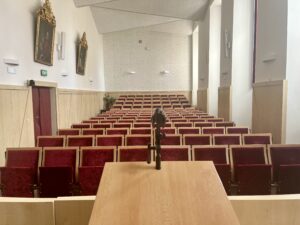

On May 4, 2026, the TRIERTIUM research group hosted a research seminar at the Sts Cyril and Methodius Faculty of Theology, Palacký University Olomouc. The seminar featured a lecture by Maurizio Maria Malimpensa (Department of Philosophy and Patrology, Palacký University) entitled “From the Doctrine of Principles to the Doctrine of the Image: A Systematic Introduction to Fichte’s Thought“.

Maurizio Maria Malimpensa received his PhD in Philosophy from the University of Padua in 2021. He has subsequently held research positions at the Faculty of Protestant Theology of the University of Vienna, the Department of Humanities at the University of Ferrara, and the Italian Institute for Historical Studies in Naples. His research focuses on Classical German Philosophy—especially the thought of Johann Gottlieb Fichte—and on modern and contemporary Italian philosophy. He is particularly interested in the systematic foundation of philosophy as a science and its intersections with theology, intersubjectivity, and aesthetics. He is co-editor of the new critical edition of Fichte’s Neue Darstellung der Wissenschaftslehre oder die sogenannte Wissenschaftslehre nova methodo (frommann-holzboog, 2025), and a member of various research networks, including the Associazione Trialogo, the Laboratorio di Filosofia Trascendentale e Fenomenologia, and the Internationale Johann Gottlieb Fichte-Gesellschaft.
Within TRIERTIUM, Maurizio Maria Malimpensa aims to systematically explore the theological and speculative significance of the category of image (Bild) in Fichte’s philosophy in light of a Trinitarian ontology, while also tracing affinities between Fichte’s elaboration of this theme and key moments in Christian thought from the Patristic era to early modernity. This lecture offered a systematic introduction to Fichte’s Wissenschaftslehre by tracing its development from the doctrine of principles to the doctrine of the image. It argued that the foundation of the system cannot be grasped as a simple identity, but only as the dynamic articulation of a plurality of irreducible acts. Drawing on Fichte’s reflections on the relation between the Absolute and its appearing, as well as on the philosophical interpretation of Christian revelation, the Malimepensa suggested that this articulation can be fruitfully understood in a trinitarian key. In particular, the relation between the Absolute and Knowledge—properly understood as Image—reveals a unity that is given only in and through distinction, echoing the irreducible correlation between Father and Son, and its participation through the Spirit. In this light, the trinitarian dimension does not appear as an external theological superstructure, but as the speculative horizon within which the inner coherence of Fichte’s system—between foundation, image, and life—can be adequately understood. In this sense, the Wissenschaftslehre clearly emerges not merely as a theory of subjectivity, but as a transcendental ontology of manifestation (as revelation).
The TRIERTIUM research seminars are organized by the TRIERTIUM research group.
More information is available at: www.triertium.cz.