
Nature Lost, Nature Regained: Rethinking Nature Across Theology, Philosophy, and the Sciences
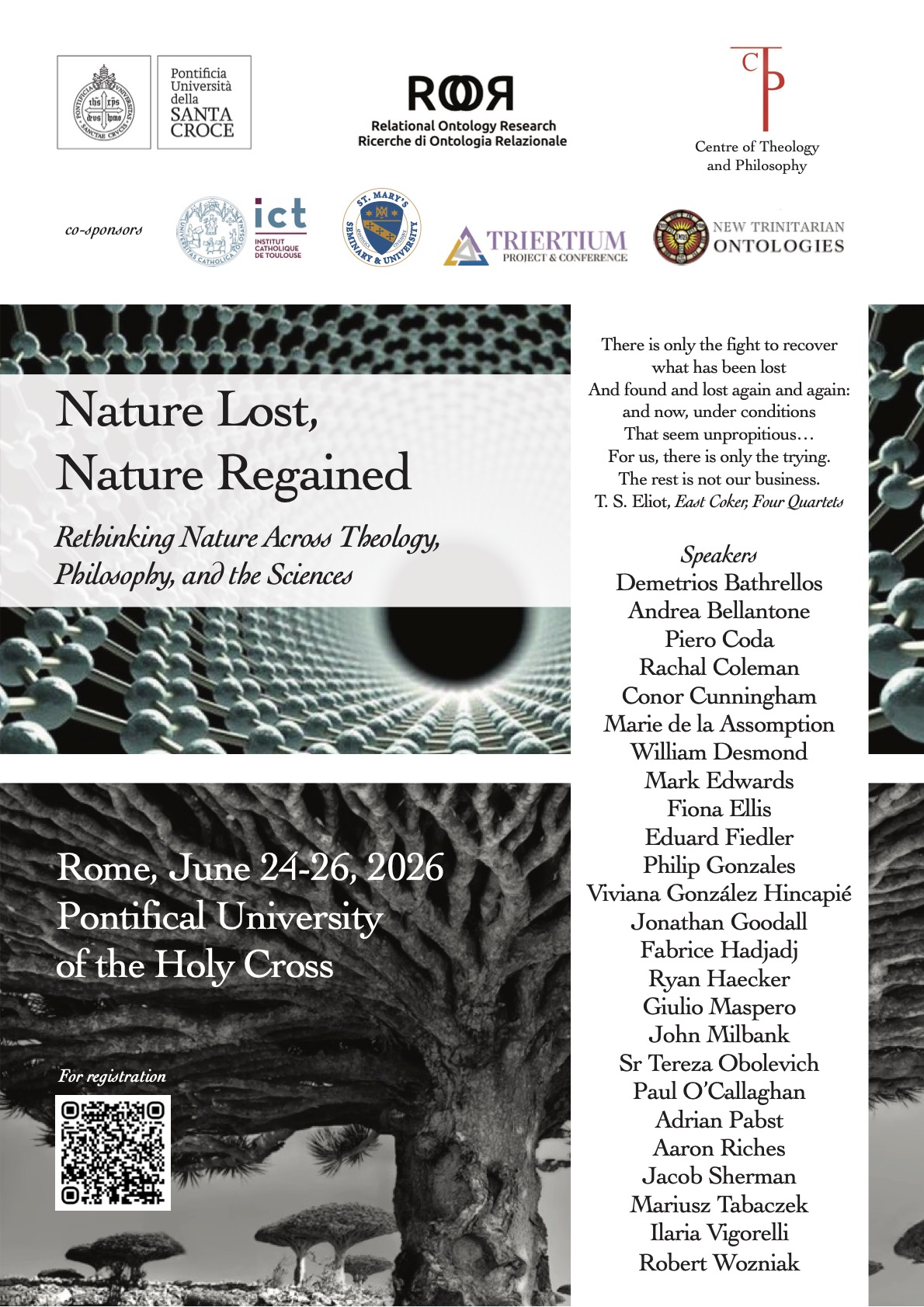
There is only the fight to recover what has been lost
And found and lost again and again: and now, under conditions
That seem unpropitious. But perhaps neither gain nor loss.
For us, there is only the trying. The rest is not our business.
— T. S. Eliot, East Coker, Four Quartet
To ask even the simplest of “natural” questions today is often to be met with impoverishment or absence. From the nearest tree or blade of grass to the mystery of the person, our age too often experiences existence as if it had flatlined. As Tom Wolfe once put it, modern man finds himself floundering in the primordial ooze, “gulping for air, frantically treading… when he feels something huge and smooth swim beneath him and boost him up, like some almighty dolphin. He can’t see it, but he’s much impressed. He names it God.”
This malaise has deep ancestry. Each age has installed its own candidate for a single, foundational “base”: Thales’ water, Democritus’ atoms, Newtonian mechanics, ether, DNA as the “secret of life,” quantum fields or strings in contemporary physics. The names change, but the ideology persists: reality imagined as a single substrate, all explanation converging to one foundation. Yet this vision was always fragile. If this is Nature Lost, how might we regain it — theologically, philosophically, scientifically?
The Centre for Theology and Philosophy, in collaboration with the Pontifical University of the Holy Cross (Santa Croce, Rome), invites scholars from across disciplines to explore this enduring and contested idea of nature. Once regarded as the very ground of intelligibility—what Aristotle called physis and the scholastics treated as a principle of order—nature in modernity has been dismantled, dissolved, or reduced to a functional mechanism. Declared obsolete by some, defended or reimagined by others, “nature” remains at the center of our deepest debates: about the human person, technology, freedom, metaphysics, and meaning itself. The conference is co-sponsored by ICT (Toulouse), St Mary Seminary and University (Baltimore), Triertium (Olomouc) and New Trinitarian Ontologies (Austin).
Demetrios Bathrellos, Andrea Bellantone, Piero Coda, Rachal Coleman, Conor Cunningham, William Desmond, Mark Edwards, Fiona Ellis, Eduard Fiedler, Philip Gonzales, Viviana González Hincapié, Jonathan Goodall, Fabrice Hadjadj, Ryan Haecker, Giulio Maspero, John Milbank, Sr Tereza Obolevich, Paul O’Callaghan, Adrian Pabst, Aaron Riches, Jacob Sherman, Mariusz Tabaczek, Ilaria Vigorelli, Robert Wozniak
We welcome proposals that critically and constructively engage the question of nature in its many dimensions, from historical, systematic, or contemporary perspectives. Contributions may draw on theology, philosophy, the natural and social sciences, literature, or cultural criticism. Submissions from both believers and non-believers are welcome.
Possible areas of inquiry include (but are not limited to):
- Metaphysical and Philosophical Accounts: Is nature an essence, a process, a horizon of intelligibility — or a fiction?
- Theological Perspectives: How do classical and modern theologies interpret nature in relation to grace, creation, and redemption?
- Nature and the Human Person: How do debates about embodiment, gender, transhumanism, andfreedom reconfigure the question of nature?
- Science and Nature: Does modern science uncover nature or abolish it? What do evolutionary theory, neuroscience, and cosmology suggest?
- Political and Cultural Dimensions: How is nature invoked in debates over law, rights, ecology, and culture?
- Technology and Artificiality: Do AI, biotechnology, and digital culture mark the end of nature — or its expansion?
- Aesthetic and Literary Reflections: How has art and literature given voice to nature, whether as lost paradise, raw force, or fragile beauty?
Submission Guidelines
Abstracts of 300–500 words (for 20-minute papers) should be submitted by March 15th 2026 (response by the end of March), sending an email to ror@pusc.it.
Panel proposals (3–4 papers) are also encouraged.
Please include a short biography (100 words) with your submission.